Every sales leader can describe exceptional results. Far fewer can describe the execution that creates them. Here’s what great execution actually looks like — and why naming it is the first real step toward building it.
Every sales leader we work with wants the same thing: exceptional results. Not fine. Not up-and-to-the-right. Exceptional.
And there’s no real argument about where those results come from. Exceptional results aren’t the accident of a good quarter or a hot market — they’re produced by excellent execution, repeated day after day. Everyone agrees on that much.
So what does excellent execution actually look like? When we ask sales leaders that question, we hear the same handful of answers again and again:
A high participation rate — a real percentage of the team carrying quota, not a few heroes covering for everyone else.
Margins that hold under pressure, even when the competition is discounting to win the deal.
Numbers you can count on, quarter after quarter — not a great Q1 and a scramble every Q3.
Every one of those is worth wanting. They’re the right ambitions.
But look at what they have in common.
They’re all outcomes.
Participation, margin, consistency — those are the output of great execution. They’re the scoreboard. Not one of them is the execution itself.
And that’s the problem underneath a lot of underperformance: we measure results with real precision, but we can barely describe the execution that produces them. We know exactly what we want. We’re far less clear on what our people would actually have to do, every day, to produce it. (It’s part of why the average B2B VP of Sales lasts only about 19 months, per CSO Insights — often hired to deliver a result no one had defined the execution for.)
Great Results Are a Scoreboard, Not a Plan
A championship team doesn’t put “win the title” on the practice plan. The title is the outcome. The practice plan is footwork, film, conditioning, set plays — the execution that makes the outcome possible.
You don’t coach the trophy. You coach the reps that earn it.
Selling is no different. “Hit the number” is a trophy. It is not a plan.
Excellent Execution Has Two Levels
So what does excellent execution actually look like? The question has two levels — and most of us only work on one.
The first is the individual level: what excellent selling looks like. What does excellent qualifying look like? Excellent handling of an objection? A presentation that connects to how the buyer actually decides? And on the management side — what does excellent coaching look like? This is familiar ground. It’s where most sales training lives, and it’s where we’ve spent years building methodology. It matters enormously; excellent individual execution isn’t optional.
But there’s a second level, and it gets almost none of the attention: excellent execution at the organizational level.
And this is the part that’s easy to miss — the organizational level is the foundation for the individual one. You can train sellers all day, but excellent individual execution only takes hold, and holds across the whole team rather than just your naturals, when the organization around them is built to produce it.
We didn’t land on that in a conference room. When our work was independently evaluated — by Western Michigan University at CommScope, and by a study using the same methods at AT&T — the finding was consistent: whether new skills actually stuck had far less to do with the training itself than with the system people walked back into. At AT&T the training was well regarded and delivered at scale. But only about half of sellers felt any real accountability for using it, the coaching meant to reinforce it largely didn’t land, and when the evaluators went back and verified who was genuinely using what they’d learned, it came to about a third.
The gap was never better training; it was a better operating system.
At CommScope, where the model was reinforced and the coaching cadence held, methodology adoption reached 75%.
That organizational picture has a name: the Sales Excellence Model.
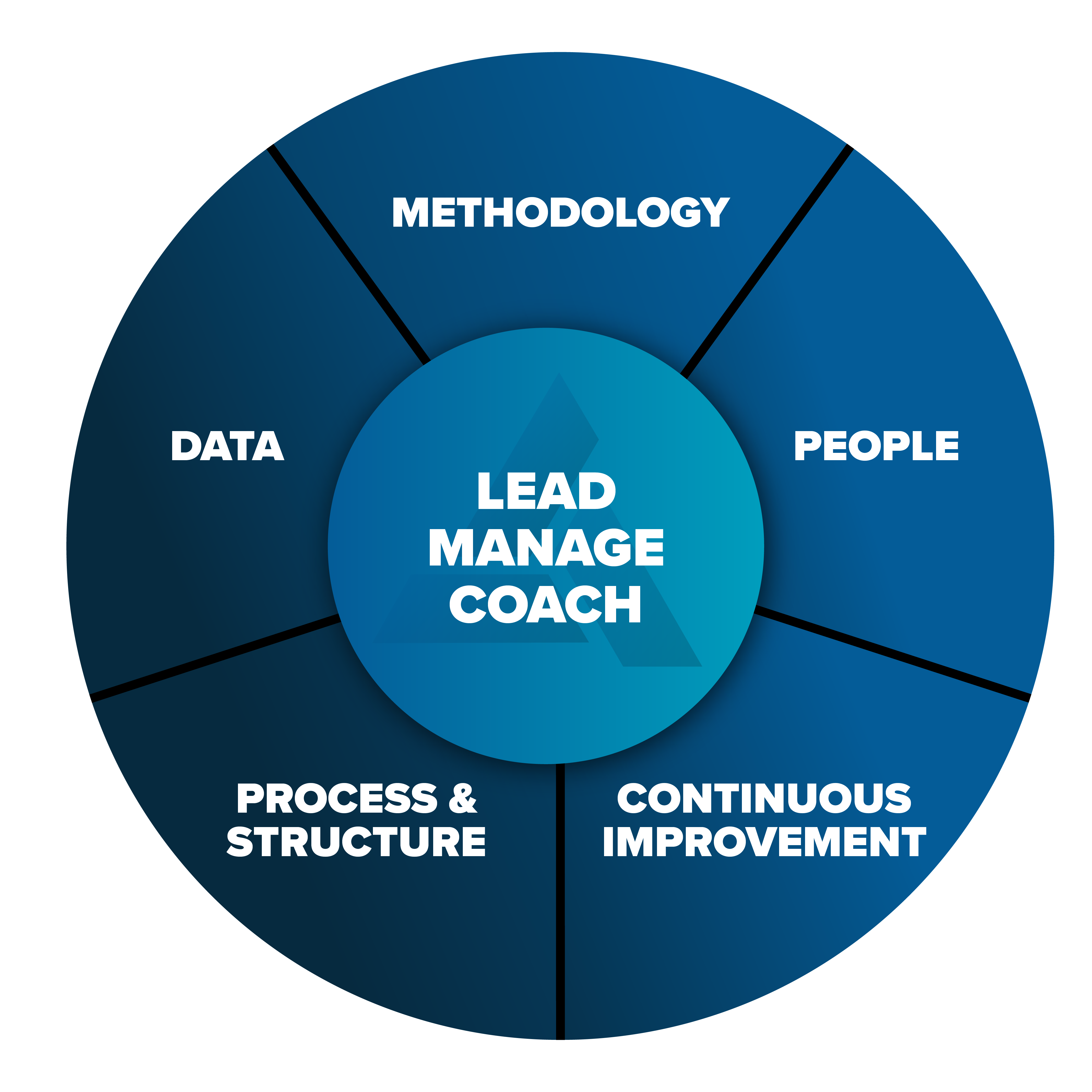
Think of it as the operating system for a sales organization — five things that, working together, make excellent execution the norm instead of the exception:
Methodology — a defined, comprehensive way of selling that positions your people as trusted advisors, not pitch-deliverers.
People — the right talent in the right seats: hired for innate strengths, developed deliberately, coachable by design.
Continuous Improvement — the engine that keeps skills sharp: learning cycles, a real coaching cadence, deliberate practice, and honest skill measurement.
Process & Structure — buyer-aligned workflows, clear roles, and an organization built to sell the way buyers actually buy.
Data — metrics used to develop people, not just inspect them: success plans, behaviors, proficiency, coaching.
At the center sits the job of every sales manager: lead, manage, coach.
An organization strong across all five doesn’t reach exceptional results by luck or by heroics. It produces them — predictably and repeatably.
The Operating System and the Operator
Look again at that first pillar. The definition of excellent individual execution — the methodology — isn’t separate from the system; it’s part of it. The model names what great selling and coaching look like, then surrounds that definition with the four things that turn it into everyone’s reality: the right people to carry it, the continuous improvement to keep them sharp, the structure to operate it, and the data to measure and coach it.
So the operator is the individual — the seller and the manager alike. The operating system is the whole model around them — the definition of great execution, plus everything required to produce it at scale.
That’s why lifting results one seller at a time — another workshop, another kickoff — so rarely holds. You’re upgrading an operator inside an operating system that never changed. Improve the system, and you lift every operator at once — which is what actually moves the participation rate, protects the margin, and turns a good quarter into a dependable one.
Excellence Is Built, Not Inspected
When leaders manage only the outputs, they’re left inspecting results after the fact — the loss already taken, the quarter already missed. There’s not much to be done with a number that’s already landed except explain it. Naming the execution opens the other door: it can be built, coached, and corrected long before it reaches the scoreboard.
None of this makes the outcomes less important. Participation, margin, and consistency are still the point. But they’re what shows up when the execution underneath is sound — and you can’t build what you haven’t defined.
So the next time you sit down with your team to describe what great looks like, go past the scoreboard. Describe the execution. Name the system that produces the number — and you’ve taken the first real step toward building it.
A good place to start is to see where you actually stand. The Sales Excellence Evaluation is a short self-assessment across all five pillars — Methodology, People, Continuous Improvement, Process & Structure, and Data — an honest read on which parts of your operating system are strong and which are quietly capping your results. Take the Sales Excellence Evaluation »
At Axiom Sales Kinetics, we’ve spent thirty years defining what excellent execution looks like at every level — and building it into how teams sell. The Sales Excellence Model is where it starts; our methodology and the Kinetics platform are how it becomes daily practice.
